
Trace Former Knox County Owners by Transfer
Start with the newest deed and its parties. Build a working timeline before older Knox County indexes. Each row should hold the transfer date, party direction, deed type, and recording reference together, so a familiar name cannot pull the chain onto a different parcel.
| Transfer Date | Grantor → Grantee | Deed Type | Book/Page |
|---|---|---|---|
| Newest recorded transfer | Prior owner → current grantee | Copy the instrument label | Copy the clerk reference |
| Next earlier transfer | Earlier grantor → prior owner | Note warranty, quitclaim, or other type | Follow any prior-reference citation |
| Earlier book entry | Earlier owner → later owner | Preserve the indexed type | Use the bound-volume citation |
Knox County Clerk deed coverage has three layers. Records go back to the 1700s. The CCLIX index reaches 1966. Most online instrument images only start in January 2004. An index lead can therefore still need an office image. It can also need an older bound volume at the courthouse.
For former Knox County property owners, direction matters as much as spelling. The grantee on one deed becomes the next search target. Hunt that party as the grantee on an earlier instrument. When that search stalls, test heirs, trustees, executors, commissioners, and sheriff entries. Only then decide the chain has ended. Split surface, mineral, life-estate, and remainder interests onto separate timelines whenever the deed language separates them.
Understand Knox County's Two Online Cutoffs
Knox County's two online cutoffs do not match. Deeds and mortgages are indexed and scanned in CCLIX back to 1966. Most instrument images start in January 2004. So the index often runs deeper than the images. A former owner can appear in the index while the deed itself still requires a trip to the courthouse in Barbourville.
eCCLIX is not an open search form either. It requires a Software Management account, a password, access fees, and special image software. The office is the free alternative. Public records, indexes, and documents cost nothing at 401 Court Square, Suite 102, Barbourville, and staff at 606-546-3568 can confirm a volume before a long drive.
Give the clerk a grantor or grantee, approximate years, and any book, page, or legal-description clue. Staff may route the request through the open-records process. The policy covers inspection forms, email, mail, fax, and walk-ins. Older owners may also need KDLA finding aids. Library help and historical-map context can point to the right deed volume.
Note: The 1966 index date does not mean every deed image from that year can be opened freely on the public web.
Follow Knox County Land, Not Just an Address
Old deeds rarely use modern house numbers. Land, not address, is the anchor. Note the subdivision or addition, lot and block, acreage, tract name, survey calls, road or creek, adjoining owners, and prior deed reference. Those clues hold a chain of Knox County owners together even after road names, postal cities, or street numbering change.
Backward-chain terms
- Grantor
- The party conveying an interest in the recorded instrument.
- Grantee
- The party receiving the recorded interest.
- Chain of title
- The linked sequence of instruments affecting the same land.
- Reverse index
- An index used to find a party in the receiving or grantee role.
- Quitclaim deed
- A transfer of whatever interest the grantor has, without the promises of a warranty deed.
- Warranty deed
- A deed carrying title promises that a quitclaim deed does not make.
Two deeds may disagree on acreage. That gap can signal a partial conveyance, easement, mineral reservation, or lot split, meaning the Knox County chain has branched.
Walk the Knox County Deed Chain Backward
Move from each grantee to the grantor who sold the property, using the Knox County Clerk records page and the office indexes. Record every reference before stepping back.
- Find the current owner's purchase deed with that owner as grantee.
- Copy the grantor, deed type, date, book/page, and legal description.
- Search that grantor as a grantee on an earlier deed.
- Repeat in office deed books or microfilm when the online trail ends.
- Grantor / grantee
- The conveying party and receiving party.
- Chain of title
- The ordered sequence of instruments affecting the land.
- Legal description
- The lot, block, tract, boundary, or survey wording that persists beyond an address.
Try Knox County Heir, Commissioner, and Sheriff Entries
The Kentucky Department for Libraries and Archives land-record method advises checking both grantor and grantee indexes. When the ordinary chain stalls, try role variants. Index headings include H for heirs, C for commissioner, and S for sheriff. Test initials and middle names too. Married names, trustee titles, and exact entity suffixes can also hide the right grantee.
Estate transfers hide in plain sight. An affidavit of descent, affidavit conversion, will, executor or administrator deed, or deed of distribution can carry ownership past a death. Forced sales sit under commissioner or sheriff. A search limited to warranty deeds misses those movements entirely.
FamilySearch's Kentucky wills and deeds collection may yield names, dates, places, or a volume citation. Its image access and coverage vary. Treat a hit as a lead. Confirm it in Knox County's official books before calling anyone a former owner of record.
Note: A different document type may preserve the prior-owner link even when no ordinary buyer-and-seller deed appears in the expected year.
Translate Old Barbourville Owners With Map Names
The Knox Historical Museum map gallery offers unusually precise search terms for former-owner work. Holdings span 1801 to 1995. The 1801 trustee layout, Sampson Addition, Boone Heights, zoning and street maps, cemetery references, farm plats, and coal-tract material all appear. Old Barbourville place names live there.
A 1945 Sampson Addition map names Flem D. Sampson property. A 1995 Barbourville and Boone Heights coal-tract map hints that surface and mineral interests may move through separate instruments. Query the clerk's index with those names. Then prove the link through a recorded legal description rather than assuming a map label matches a modern subdivision.
The gallery itself is a doorway. Use it to translate old tract names into modern Knox County deed searches.
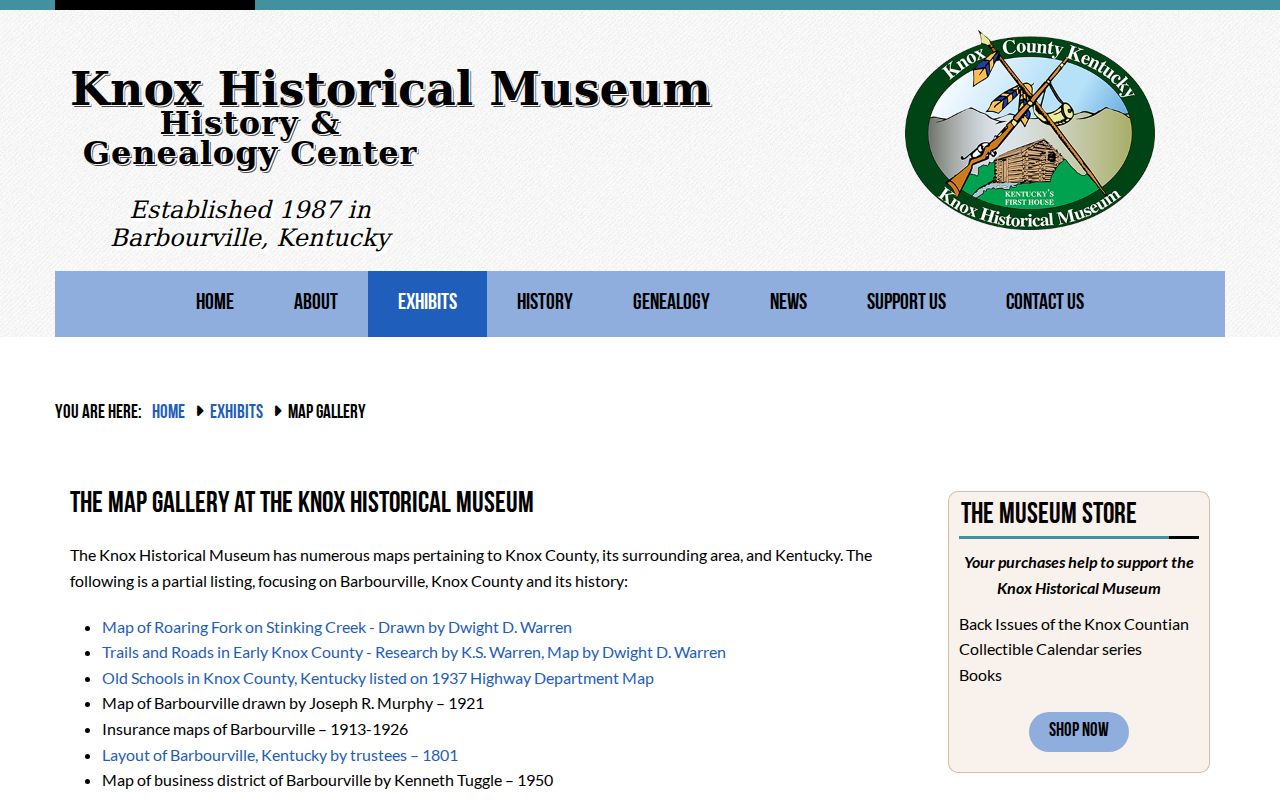
The gallery can translate an old tract clue. The clerk's deed books remain the evidence for each former Knox County owner.
Search Lynn Camp Before Corbin in Older Records
Corbin carried the name Lynn Camp until its 1885 renaming. Incorporation came in 1895. A missing deed may simply hide under the older name. Search both before giving up. Modern Corbin spills across Knox, Whitley, and Laurel Counties. That means an old property trail may sit in another county's deed books entirely. A postal address or municipal limit is not a deed boundary. Route the search with the county name, the legal description, a road or creek, and the adjoining owners. The Kentucky Secretary of State's city records can date an incorporation or annexation for context. Only the proper county recorder supplies the deed chain.
How Far Knox County Ownership Records Reach
Knox County deed records did not begin in 1966. That year is the stated reach of the CCLIX deed and mortgage index, not a starting line. For earlier owners, ask the clerk about grantor and grantee indexes, books, microfilm, and which individual volumes survive. Consult Kentucky Department for Libraries and Archives resources. Its disaster table lists no Knox disaster year.
Coverage limit. CCLIX reaches deeds and mortgages to 1966; earlier prior owners require the clerk's books, microfilm, or archive finding aids.
A stalled chain often hides a non-sale transfer. The KDLA method points to three initials. H marks heirs, C marks commissioner, and S marks sheriff in the index. Estate affidavits, wills, and executor deeds can carry title where an ordinary sale deed never existed. Court-ordered transfers can do the same. Barbourville's museum maps can also translate old clues like Sampson Addition, Boone Heights, or Fighting Creek into terms you can actually trace. The 1801 trustee layout is another clue they can decode.