
Identify Who Owns a Knox County Property
The shortest reliable route runs from address to PVA record to deed. Knox County's official qPublic link does not load. The county office is the sound fallback. Skip unverified third-party results for now. Keep every identifier you collect, because each one bridges a different records system.
- Give the Knox County PVA the complete situs address and ask for the parcel identifier and January 1 owner-of-record entry.
- Use that owner name and deed reference with the Knox County Clerk's Legal Records Department.
- Read the most recent deed's grantee, recording date, legal description, and prior-instrument reference.
- If the grantee is an entity, check its exact legal name in the Kentucky Secretary of State business search.
Two independent county records answer the question of who owns this property. That cross-check catches mismatches worth resolving. A newer deed may postdate the assessment, or a Corbin address may sit outside Knox County entirely.
When the Knox County Owner Card Will Not Load
The Kentucky Department of Revenue directory lists Knox qPublic as the county's parcel tool, but that endpoint does not return a working parcel card. Do not assume the PVA has no record. Call the Knox County PVA at 606-546-4113 and ask staff to search the office roll by the situs address.
Ask for the owner name exactly as it appears on the roll, the parcel number, the mailing address, the situs address, the legal-description reference, the assessment year, and any deed reference on file. Copy the office entry verbatim rather than guessing how an online card would be laid out.
Note: The PVA's annual roll is an ownership lead, while the newest recorded instrument is the better confirmation after a recent closing.
Knox County's January 1 Owner Snapshot
Kentucky assessments are keyed to January 1. The owner listed for a tax year can predate a deed recorded later that same year. State tax guidance describes one common result. After a transfer, the tax bill may name the new owner "in care of" while the roll keeps the January 1 owner of record.
Four labels that should stay separate
- Owner of record
- The party carried on the dated assessment roll.
- Situs
- The physical location used to identify the parcel.
- Mailing address
- The place tax or assessment correspondence is sent.
- Grantee
- The party receiving an interest in a recorded deed.
A remote mailing address does not mean the wrong parcel turned up. Nor is the person at the situs necessarily the owner of record. Compare the parcel number and legal description before deciding the two records conflict.
Trace the Knox County Owner to the Newest Deed
The Knox County Clerk records page says deeds and mortgages are indexed in CCLIX back to 1966. Most instrument images from January 2004 forward are online. eCCLIX requires an account, a password, access fees, and special image software. Public indexes, documents, and images remain free in the clerk's office.
| Check | What it contributes | Currency limit |
|---|---|---|
| PVA roll | Dated owner name, parcel and mailing lead | January 1 snapshot |
| Latest recorded deed | Grantee, legal description and transfer date | Newest indexed filing |
| Secretary of State | Business entity identity and filings | Not proof that the entity owns this parcel |
| City or state boundary map | Jurisdiction context | Not a title or parcel-owner record |
For a deeper look at the current assessment entry, see the Knox County current property owner guide. The deed and the roll should describe the same land. Address formatting may differ even when the parcel matches.
Decode Knox County LLC, Trust, and Estate Owners
An owner result may name an LLC, trustee, executor, administrator, heir group, or commissioner. Individuals are not the only owners of record. Search the exact entity spelling in the Kentucky business entity search. Try common suffix variants there too. Treat its registered-agent address as an entity contact, not the property's mailing address. For trusts, search the trust and the trustee both. For an estate, watch for affidavits of descent or conversion. Executor or administrator deeds, wills, and probate instruments also appear. Kentucky land-record guidance suggests trying H for heirs, C for commissioner, and S for sheriff. Use those letters when a person-name trail stops. The Secretary of State search shown below is a solid identity cross-check. It works best after a Knox County deed names a business owner.
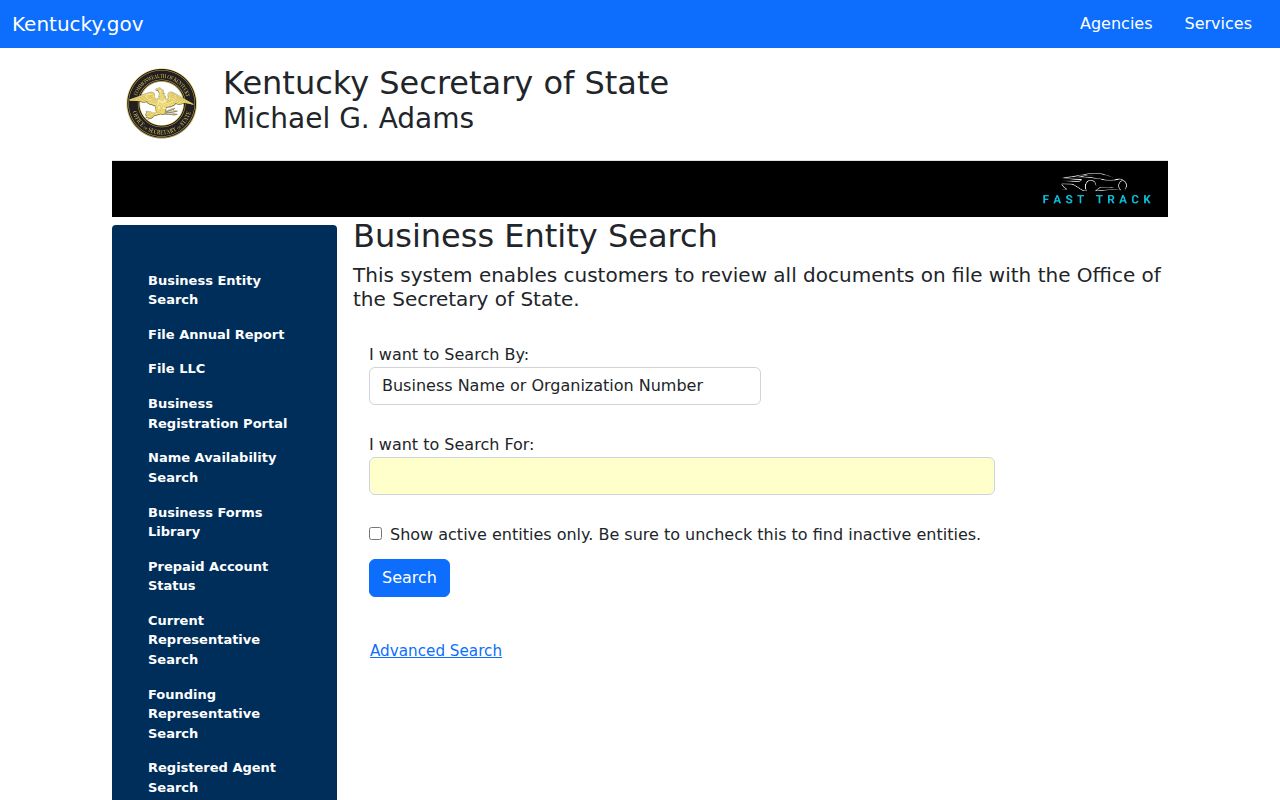
The search selector, name box, and active-only filter help separate lookalike entities. Still, the recorded Knox County deed remains the parcel-specific evidence.
Where Knox County Property Ownership Is Recorded
Ownership evidence lives in several offices. The PVA supplies the dated assessment view. The county clerk records transfers. State resources clarify entity names or incorporated-city boundaries. Knox County offers no public parcel GIS map or adjacent-owner tool, so a generic statewide map is no substitute for a local property records lookup.
| Source | Owner Info It Gives | Access |
|---|---|---|
| Knox PVA roll | January 1 owner lead and parcel context | Office request; listed web endpoint unavailable |
| Knox Clerk deed index | Grantee on the latest recorded transfer | Office free; eCCLIX paid and gated |
| Secretary of State | LLC or corporate identity details | Public entity search |
| Recorded plat or deed description | Lot, block, tract and adjoining-land clues | County clerk |
None of these sources proves who occupies a home. Ownership can be split, reserved, passed through an estate, or held by a legal entity. Read the instrument itself instead of trusting a displayed name.
Verify the County Before Tracing a Corbin Owner
Corbin sits in three counties: Knox, Whitley, and Laurel. A Corbin mailing address proves nothing about jurisdiction. Neither does a utility connection. Verify the county first through a legal description, a deed reference, or incorporated-city boundary context. The Kentucky incorporated-city boundary service supplies that context. It is not a Knox parcel card, though. Then use the recorder and PVA for whichever county holds the deed. If a property search fails in Knox County, test Whitley and Laurel. Only then change the owner's spelling.
Resolve Knox County Estate Owners
A death rarely produces one clean deed. In Knox County, property can move through a will, intestate succession, an affidavit of descent, an executor or administrator deed, a court order, or a deed signed by heirs. So an estate name or the word "heirs" on an ownership lead deserves more than a quick name search. Property records hold the answer, but only if you read them carefully.
Begin with the newest recorded instrument. Note every role it names. The grantor transfers an interest. The grantee receives it. An executor or administrator acts for the estate, while a commissioner may sign under court authority. Compare the legal description and the prior deed reference, then ask the Knox Circuit Clerk for the local probate file when the land record points to a case. Older wills, settlements, and order books may sit in local volumes or on Kentucky Department for Libraries and Archives microfilm.
Estate records explain authority and the path of transfer. They do not replace the recorded deed. When several heirs keep shares, one name alone cannot answer who owns every interest in the parcel.
Monitor a Confirmed Knox County Owner Name
Confirm the right deed or mortgage first. Knox DOC ALERT then offers a free way to watch a personal, business, or trust name. Signup asks for the county. It also asks for the name, an email, and whether a business or trust is involved. Treat each alert as a prompt to inspect a filing. It is not proof of fraud or a change of ownership.
Use the Knox DOC ALERT page only after settling on the exact indexed spelling. A broad or misspelled name may miss a match. Alerts also cannot replace periodic checks of the official deed record.
What a Knox County Ownership Lookup Cannot Prove
A name answers a narrow question about public records. It does not tell you who lives at the address. It does not resolve every lien or mineral reservation. It will not locate an unrecorded claim or provide a title opinion. Kentucky's Safe at Home program can substitute a protected mailing address too. So a missing residential address in the property records is not evidence of bad data.
Use the result with care. An owner name is not a title search, and public details may be used only for lawful property research, never to target or harass anyone.
Have a purchase, estate, boundary, or mineral question? Take the full instrument chain to a qualified title professional or attorney. A Knox County owner lookup is a starting point. It is not a guarantee.
Kentucky Safe at Home adds another lawful privacy limit. Eligible survivors may use a substitute state address with mail forwarding. The program affects address disclosure in state and local records. A substitute mailing address does not weaken a deed. It also does not prove the owner lives away from the parcel. It simply means the public result must be read within the protection Kentucky provides.