
Knox Tax Record Fields
PVAs in Kentucky value real property each year. They estimate fair cash value for every parcel. The PVA holds the value and owner snapshot, the sheriff collects the first bill, and any amount still unpaid after April 15 transfers to the county clerk.
| Field | What It Shows | Where |
|---|---|---|
| Land and improvements | Parts of the annual assessment | Knox PVA |
| Fair cash value | PVA estimate for the tax year | Knox PVA |
| Exemptions | Qualified assessment reduction | Knox PVA |
| Tax bill and status | Charge and collection stage | Knox Sheriff |
| Delinquent certificate | Unpaid claim after transfer | Knox Clerk |
Fair cash value is the PVA's estimate for the assessment. It is not automatically the recorded sale price. Rates and exemptions also shape the amount due, so read the tax year beside every figure the county publishes.
January 1 Sets Knox Ownership
Kentucky sets January 1 as the ownership date for its tax roll. A deed recorded later can name a new grantee. The tax record still lists the prior owner. Both entries are accurate for their own dates. The mismatch is a timing question rather than an error.
Compare deed execution and recording dates against the tax year. Ask the PVA when a transfer enters the roll. The newest recorded deed is the stronger clue to a later transfer. The roll still governs the yearly assessment snapshot.
Note: Date the roll, bill, and deed separately. A normal update lag should not be mistaken for an ownership error.
Annual Knox Property Valuation
The Kentucky Department of Revenue requires PVAs to assess real property yearly at estimated fair cash value. Every parcel is physically inspected at least once every four years. New construction is inspected annually. Sales-comparison, cost, and income methods may apply.
The county's qPublic link does not currently work. Call the PVA at 606-546-4113, or write PO Box 1509, Barbourville, KY 40906, and request the owner, situs, mailing address, parcel number, land value, improvement value, exemptions, and tax year.
The Kentucky assessment-process source covers the statewide framework.
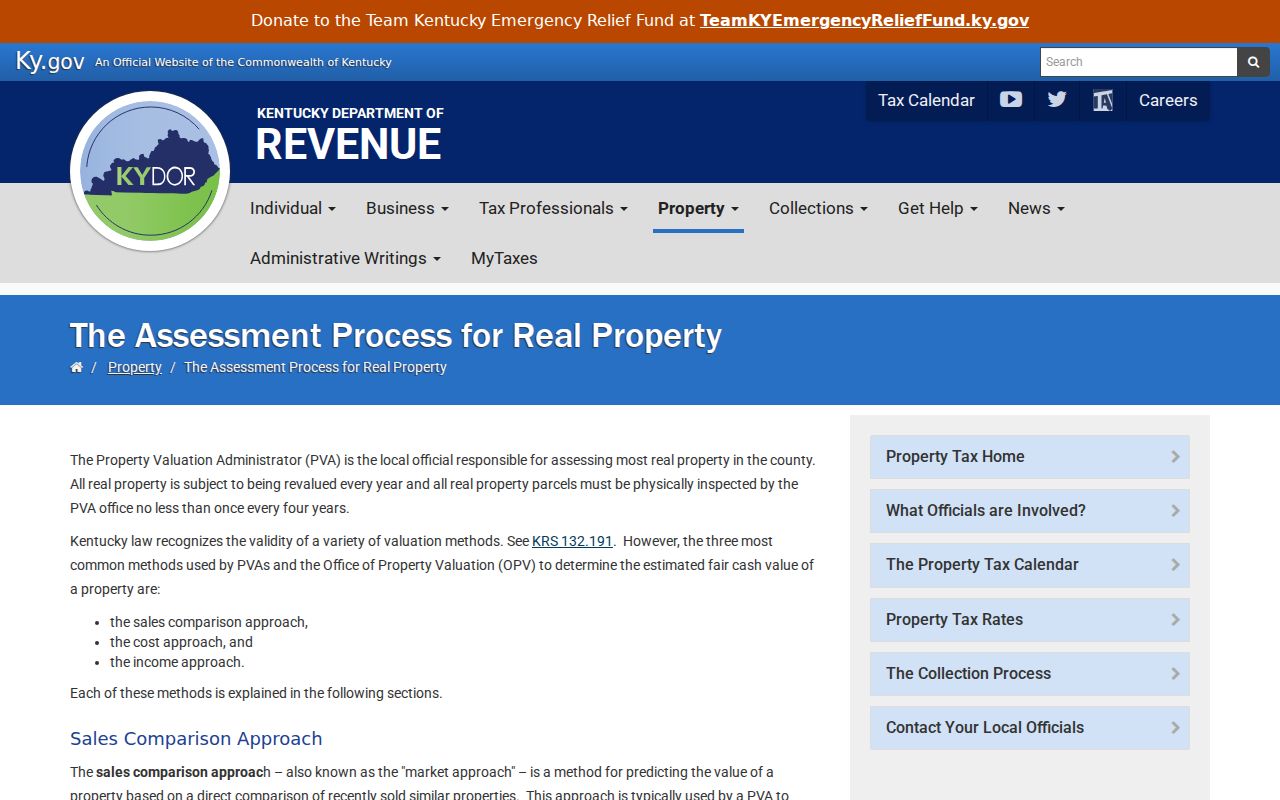
This state page supports the annual valuation cycle and office fallback described here.
Knox Property Tax Exemption
Kentucky's homestead exemption rests on KRS 132.810. The Department of Revenue spells out the age and disability routes and supplies Form 62A350. The published amount for 2025 and 2026 is $49,100. Applicants should confirm the current figure and required proof with the PVA.
An exemption trims the qualifying assessment used for the tax bill. The deed, lot line, and market evidence stay untouched. Ask whether it appears on the Knox parcel card. Confirm which tax year it first affects.
Find a Knox Tax Bill
The PVA's web address does not currently work. Call 606-546-4113 for the parcel card, then take that parcel number to the Knox Sheriff tax office. Its page still shows only an old notice, not a current search.
- Confirm the address and county, especially for Corbin.
- Request the PVA parcel number and assessment year.
- Match the parcel to the sheriff collection record.
- Ask the clerk whether an unpaid bill transferred after April 15.
- Assessed value
- The value placed on the annual roll.
- Levy
- The rate applied by a taxing authority.
- Homestead exemption
- A qualified reduction under Kentucky law.
- Tax lien
- A claim securing unpaid tax.
The Knox Sheriff tax page still shows an old notice. It documents a limit rather than a current database.
Contact the sheriff for a current bill and payment statement.
Delinquent Knox Tax Certificates
The sheriff takes initial real-property tax collection. Any bill still unpaid after April 15 transfers to the Knox County Clerk as a certificate of delinquency. Delinquent taxes and liens are clerk records.
A certificate is not proof of ownership. Sale notices, assignments, redemption steps, releases, and any later deed are separate events in the county's deed records. Ask the clerk about its current status.
Note: Search by parcel and owner because an assigned certificate may be indexed apart from the sheriff's original bill.
Fair Cash in Knox Tax Records
A Knox assessment and a recorded transfer can show different numbers without conflict, because the PVA estimates fair cash value. A deed may instead state the consideration used for transfer tax under KRS 142.050, which charges $0.50 per $500 of value or fraction unless exempt.
Non-gift deeds count actual consideration and liens. Gift or nominal-consideration deeds use estimated open-market value. Neither figure is a private appraisal. The Knox County value page explains these distinctions without rebuilding the tax-bill process.
Knox Property Tax Calendar
The tax trail changes hands through the year. The PVA fixes the assessment roll as of January 1 and handles the listing, inspection, conference, and assessment-review stages. The sheriff then handles the initial bill and collection stage. An unpaid bill later moves to the county clerk as a certificate of delinquency, where assignments, liens, releases, and sale records may become part of the legal-record search.
Keep the tax year attached to every request. A current balance, a prior-year assessment, and a certificate recorded after April 15 are not interchangeable. Ask the PVA for the assessment card and effective year, the sheriff for the bill and payment status, and the clerk for any transferred certificate or release. If a deed was recorded after January 1, note both the grantee and the tax-roll owner because the yearly bill can lawfully retain the earlier name.
Request Knox Tax Records
Start with a phone call. The Knox PVA at 606-546-4113 can supply the parcel card and assessment details. Ask the sheriff about the current bill and the tax year. Payment status and any printed statement can be requested in the same call. Delinquent bills change hands. Those files move to the Knox County Clerk. The clerk holds the certificate, assignments, sale materials, and release under the same parcel and owner names.
Write the request down when you can. A focused letter should name the parcel, situs address, and owner. It should also list the tax year and the exact document sought. The Kentucky Open Records Act opens a route. It applies when an identifiable record is not posted online. The clerk's inspection form works by hand delivery, mail, fax, or email, with fees and postage due in advance. Ask the custodian for the current copy price before ordering. The office's written answer is the source to cite. The sheriff web page is stale. The PVA portal is unavailable. No live Knox account remains to check.
Contest a Knox Assessment
Start with a PVA conference. Kentucky sets an annual inspection period for that first conversation about the assessment. If the value still seems wrong, file through the county clerk for local board review and bring sales evidence, condition facts, photographs, or an appraisal, confirming that year's dates with both offices.
Appeal window. Confirm the current inspection and filing dates before waiting for a bill; missing the statutory window can end local review.
Limits of Knox Tax Records
Property tax records answer assessment and collection questions. They do not prove surveyed boundaries, clear title, building condition, or current sale value. The owner line can lag a deed. It reflects January 1 ownership even after a later transfer. Mailing and situs addresses can differ.
Match each question to its record. The clerk's deed shows transfers. A licensed survey settles disputed lines. The PVA confirms exemptions and appeals. Payment and delinquency questions go to whichever office holds that stage. That keeps Knox property tax research tied to what each record actually proves.
Evidence for Knox Tax Appeals
Kentucky's appeal form asks for numbers, not complaints. The property owner's estimate of fair cash value must be broken into land, improvements, and total figures. The form also wants the property location or description, the reasons for the appeal, a signature, and contact details. That layout explains why a bare claim of a too-high value falls flat. Build the file instead. Comparable sales, photographs, repair facts, measurements, and a professional appraisal all support the number you claim.
Conference comes first. Meet with the PVA during the annual inspection period, and if no agreement follows, the county clerk takes the next local filing for board review. Confirm that year's dates with both offices. The filing point follows the inspection period. Keep proof of delivery for every exhibit. The board reviews the assessment only, not title or a disputed boundary, so a deed or survey may help identify the parcel but cannot replace value evidence.
Reading Knox Tax Status
Paid, unpaid, delinquent, assigned, released, and sold all describe different stages. The sheriff's record comes first for a bill. It also answers payment status questions before any transfer. After transfer, the clerk's certificate becomes a lien record. An assignment moves it elsewhere. A release shows the claim was resolved, but no entry alone proves that ownership changed.
Match parcel, owner, and tax year at every step. Then look for notices, assignments, redemption activity, releases, and any later deed in the deed records. A tax-sale interest follows Kentucky's statutory process. A certificate is not an immediate deed, and the sheriff's web page posts an old notice rather than a current searchable Knox account, so direct confirmation is essential. Ask which office controls the balance and request the dated record from that custodian.