
Knox Deed Types Explained
The Knox County Clerk records every land instrument that comes before it. A deed names the grantor and the grantee. It also states the form of transfer and describes the land being recorded. The same collection holds more than deeds. Easements, restrictions, mortgages, liens, assignments, and releases sit in the same legal-record series. Most of them affect land without transferring ownership.
| Deed Type | What It Does | Common Use |
|---|---|---|
| Deed | Conveys an interest to a grantee | Ordinary transfer |
| Correction deed | Repairs an earlier recorded deed | Name or description error |
| Affidavit of descent | Places heirship facts in the record | Estate transfer research |
| Condominium deed | Defines a unit interest | Condominium ownership |
| Easement | Records a right to use land | Access or utilities |
A mortgage secures debt. A lien asserts a claim, and either can encumber the land long after a loan closes, so search for a later assignment, release, or satisfaction before treating the encumbrance as still open.
Knox Index Dates Differ
The Knox County Clerk Legal Records Department page offers three distinct coverage clues. CCLIX indexes and scans deeds and mortgages back to 1966. Most filings and images online begin in January 2004. Knox records reach back to the 1700s. The clerk says so. Each statement describes a different layer of access.
An old index hit may exist without a viewable image. Earlier books can sit in the office. The online index stops decades later. Copy the party names, document type, date, and book/page or instrument reference before you go. Then use the clerk's free office access for the missing item.
Note: The 1966 date marks the stated CCLIX reach for deeds and mortgages, not the start of Knox County land records.
Inside the eCCLIX Login
The eCCLIX service is a paid convenience layer. An account, a password, access fees, and special image software are all required, and the public screen stops short of the deed search itself.
| Visible Field | Control | What It Does |
|---|---|---|
| User Name | Required text | Identifies the account |
| Password | Required password | Authenticates the account |
| Remember Me | Checkbox | Retains login choice |
| Subscribe | Account link | Begins paid access |
The public eCCLIX page displays no address, parcel, document-type, date, grantor, or grantee fields. Those search options sit behind the eCCLIX account gate. Searchers without a subscription cannot reach them. The county office remains the free route to indexes and documents.
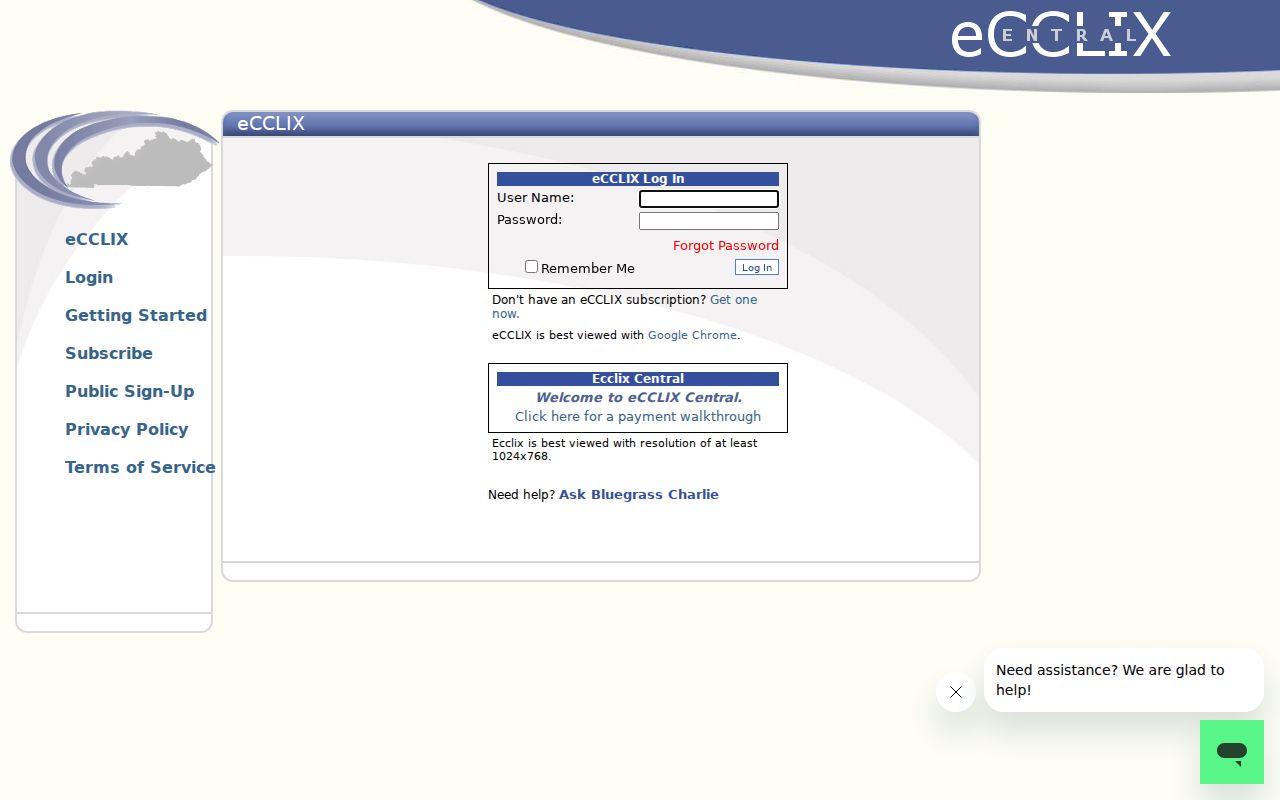
The login screen points searchers back to the office.
Walk Knox's Deed Chain
A chain starts with the newest deed on the tract. The grantee gains; the grantor gives. Record the legal description at every step, because a shared name or a neighboring tract can pull the search off course.
- Find the current owner's acquisition deed with that owner as grantee.
- Copy the grantor, recording date, deed type, legal description, and prior reference.
- Search that grantor as an earlier grantee and compare the tract wording.
- Repeat until the online trail ends, then move to office books or archive copies.
Check both grantor and grantee indexes. That is the Kentucky archive method. Try H for heirs, C for commissioner, and S for sheriff when an ordinary name chain breaks; those variants can surface estate, court, or tax-related transfers.
- Grantor
- The party transferring an interest.
- Grantee
- The party receiving it.
- Chain of title
- The ordered series of instruments tied to the same land.
- Recording reference
- The book/page or instrument number used to retrieve a filing.
Knox Liens Need Releases
The clerk indexes deeds alongside mortgages, mechanics liens, tax liens, assignments, and releases. Match each encumbrance to its later release. A modification, subordination, or assignment can shift who holds the claim, so a name-only result is incomplete. Lis pendens is notice of litigation. It does not decide who owns the tract. The court file explains the dispute, while the final deed, judgment instrument, or release shows what actually entered the land record.
Kentucky Deeds Record Value
KRS 142.050 taxes the grantor. The real-estate transfer rate runs $0.50 per $500 of declared value or fraction, unless an exemption applies. Value is not always the sale number. For a non-gift deed, value includes the actual consideration plus any liens. Gifts and nominal transfers use estimated open-market value instead. Recorded consideration is not the PVA's annual fair-cash-value assessment either, because Kentucky valuation rules govern the assessment side. Compare dates and definitions first.
Historic Knox Deed Clues
Older Knox County deed records often skip street numbers entirely. A creek, road, farm, addition, or adjoining owner may stand in for an address. The Knox Historical Museum map gallery helps here. It lists Sampson Addition, Boone Heights, Fighting Creek, the Laura Grindstaff Farm, and a 1967 street and lot-number map. One 1995 Boone Heights coal-tract map is a prompt to split surface research from mineral research. A surface deed may not carry every interest. So search mineral leases, reservations, assignments, easements, and releases. The Kentucky Department for Libraries and Archives, the local library, and the clerk's deed books offer further fallback routes.
Get a Knox Deed Copy
eCCLIX works when its paid account and image system cover the filing. Otherwise the office index and documents are free to inspect. For a remote request, send the clerk both party names, the approximate date, the document type, and the recording reference. Say whether a plain or certified copy is needed.
The clerk's recording schedule lists a deed at $50, a correction deed at $46, and an easement at $50. It adds $3 per page after the first five. Those are filing charges, not a certified-copy quote. Ask the office for the current copy cost. A records request can also go through the clerk's documented office channels when no portal supplies the item. Kentucky's Open Records Act provides another route. A precise index citation usually saves time and copy expense.
Recorded, not guaranteed. Knox County deed records show what reached the clerk. They are not a title opinion, and unrecorded interests or survey conflicts may still exist.
Knox Clerk Request Channels
Have the index citation ready before sending a remote request. That single detail saves the Knox County Clerk real time. The Request to Inspect Public Records form can be hand delivered. It can also be mailed to 401 Court Square, Suite 102, Barbourville, Kentucky 40906. Fax works too, at 606-546-3589, as does email to mike.corey@ky.gov. Fees and postage are due in advance. Kentucky law then gives the office five working days, weekends and legal holidays excluded, to issue a written determination. Any denial must cite the exemption relied upon.
Describe the deed precisely. Give the grantor and the grantee. Include the instrument type, an approximate recording date, and the book/page or document number. A subdivision, lot, tract, or road name helps separate parties with similar names. Inspect first before ordering copies in bulk. Noncommercial copies run $0.50 per page. A noncommercial recording, disc, or tape costs $5, subject to statutory fees. Those charges sit apart from the clerk's instrument recording fees.
Knox Deed Fraud Alerts
The Knox DOC ALERT service posts a watch on a deed or mortgage only after it is confirmed. Registering takes the county and the watched name with its confirmation. You also supply an email address. Note whether the name belongs to a business or trust. Spell the name exactly as the recorded instrument carries it. A business owner may need the Kentucky Secretary of State entity search first. That search confirms the registered form of the name.
Remember what an alert is not. It is a notice, never a block on recording. It cannot judge a document forged. Nor can it remove an instrument or substitute for a fresh search of Knox County deed records. Treat any message as a prompt to pull the actual clerk entry and image. Contact the clerk when a filing breaks the known chain of title. Seek legal help whenever ownership or fraud is disputed.
Knox Deeds Beyond Street Names
Older Knox deeds rarely carry a modern street address. So do not force a street match. Search the owner in both grantor and grantee indexes, then weigh the tract language itself. Lot and block, an addition name, acreage, a road or creek, adjoining owners, and metes-and-bounds calls can pin down the land. Metes and bounds trace a tract through courses, distances, and physical calls. A recorded plat can translate a subdivision lot, but the deed's legal description remains the true conveyance text.
Barbourville map titles hand you bridge terms. Sampson Addition, Boone Heights, Fighting Creek, and Laura Grindstaff Farm all work. Carry a matching term back to the Knox clerk index. If the chain involves a surface and mineral split, widen the net to reservations, mineral leases, assignments, easements, and releases. One surface deed never proves every mineral interest followed it. Copy each prior reference. Compare the same tract at every step. When an heir, commissioner, or sheriff breaks the ordinary chain, check the H, C, and S index variants used in the Kentucky archive method. Estate and court files may explain the transfer, yet the resulting instrument still has to match the Knox legal description.
Preserve Knox Deed Citations
Record the grantor, grantee, recording date, instrument type, and book/page citation whenever a Knox County deed checks out. A full citation is what lets the recorder's clerk pull that same deed from the shelf again.